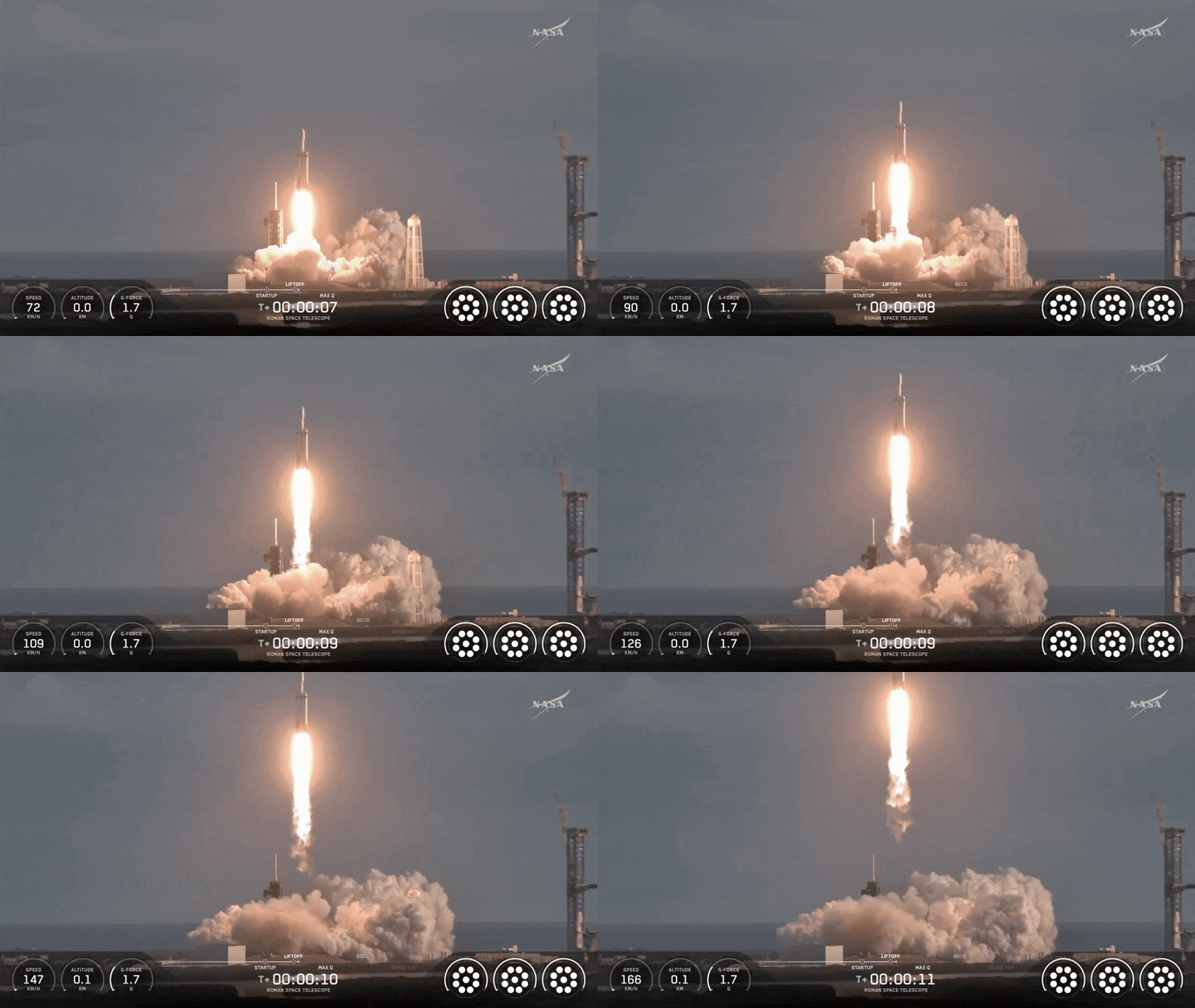
NASA is preparing to launch its next major astronomical observatory, the Nancy Grace Roman Space Telescope, designed to unlock some of the greatest mysteries of the universe. Scheduled for deployment in the coming years, the advanced facility aims to transform humanity's understanding of the cosmos by focusing on elusive cosmic phenomena. Researchers and engineers have built the instrument to capture wide-field infrared images that will dwarf the coverage capacity of older observatories.
Among the primary objectives of the mission is the investigation of dark energy, the mysterious force that accelerates the expansion of the universe. While ordinary matter and standard gravity pull celestial bodies together, dark energy pushes galaxies apart across vast distances. By measuring the distribution and shape of countless distant galaxies, the Roman telescope will help scientists map this expansion history with unprecedented precision. Understanding this force remains one of the most significant challenges in modern physics.
The telescope will also expand the search for worlds beyond our solar system, commonly known as exoplanets. Utilizing a technique called gravitational microlensing, the observatory can detect distant planets that orbit far from their host stars, including rogue worlds drifting through space without a solar system. This method allows researchers to spot bodies that traditional planet-hunting instruments typically miss. The data gathered is expected to reveal how common planetary systems are throughout the Milky Way galaxy.
Additionally, the mission will observe enigmatic black holes and analyze the structural evolution of galaxies over billions of years. By peering deep into crowded cosmic regions, the telescope will track how these gravitational powerhouses influence their surrounding environments. The resulting insights will provide a clearer picture of galactic formation from the early universe to the present era.
Named after NASA's first chief astronomer, often regarded as the mother of the Hubble Space Telescope, the Roman mission represents a massive technological leap forward. Its unprecedented field of view will allow scientists to survey large swathes of the sky much faster than previously possible. As preparations continue, the astronomical community anticipates a wealth of groundbreaking discoveries that will reshape astrophysical textbooks.
Reporting based on coverage first published by The Times of India. Read the original report at The Times of India.