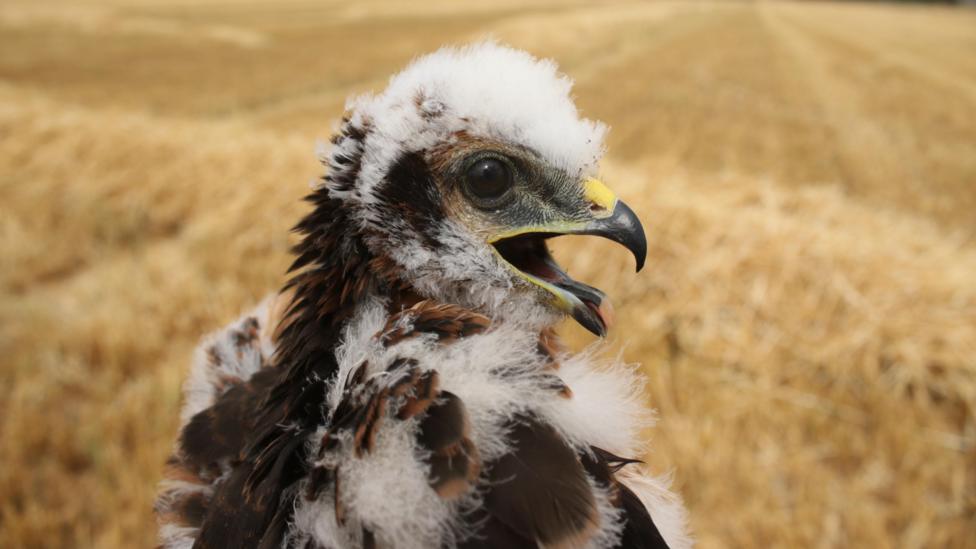
Britain's rarest resident bird of prey has achieved a rare breeding success for the second consecutive year, according to updates from the Royal Society for the Protection of Birds. Conservationists confirmed that a single male Montagu's harrier successfully raised six chicks across two nests located on private English farmland. The birds utilized the exact undisclosed region where a smaller brood was successfully raised last year.
The species remains in a precarious conservation status in the United Kingdom, having been classified on the official red list of highest-risk birds in 2021. Populations experienced a significant downward trend following a peak of nine successful breeding pairs in 2011, culminating in a multi-year period with no confirmed breeding success. Organization representatives expressed relief at the recent outcome, noting that intensive efforts are underway to prevent the raptor from disappearing from the country entirely.
Securing the nests required close collaboration between wildlife charities and local agricultural landowners. Protective fencing was installed around the nesting sites to shield the vulnerable ground-dwelling families from mammalian predators such as foxes. The breeding male played a crucial role in the survival of both broods by continuously hunting to supply food for the two groups of growing nestlings. Observers noted that the raptors displayed their characteristic aerial food transfers, where the male releases prey in mid-flight for the female to catch upside down in her talons.
Montagu's harriers are slender, long-winged migratory birds that spend the winter months in Africa before returning to Europe during the summer. Because they frequently choose agricultural fields for nesting, their ground-level nests face severe threats from modern farming practices. Conservation leaders pointed out that shifting weather patterns and climate pressures have accelerated agricultural timelines, with the harvest arriving roughly a month earlier than in past years and elevating the risk of nests being accidentally ruined by heavy machinery.
To address gaps in scientific knowledge regarding the species, conservationists took a major step this season by fitting two of the fledged juveniles with satellite transmitters. Wildlife researchers hope the tracking devices will reveal crucial data about the migration routes used by young harriers, the duration of their stay abroad, and their potential return timeline to British shores. Wildlife officials have encouraged birdwatchers to remain vigilant for the fledglings and to submit any local observations to the dedicated monitoring hotline established by the RSPB.
Reporting based on coverage first published by BBC News. Read the original report at BBC News.


